Legislative Scorecards: Providing data for voters and advocates
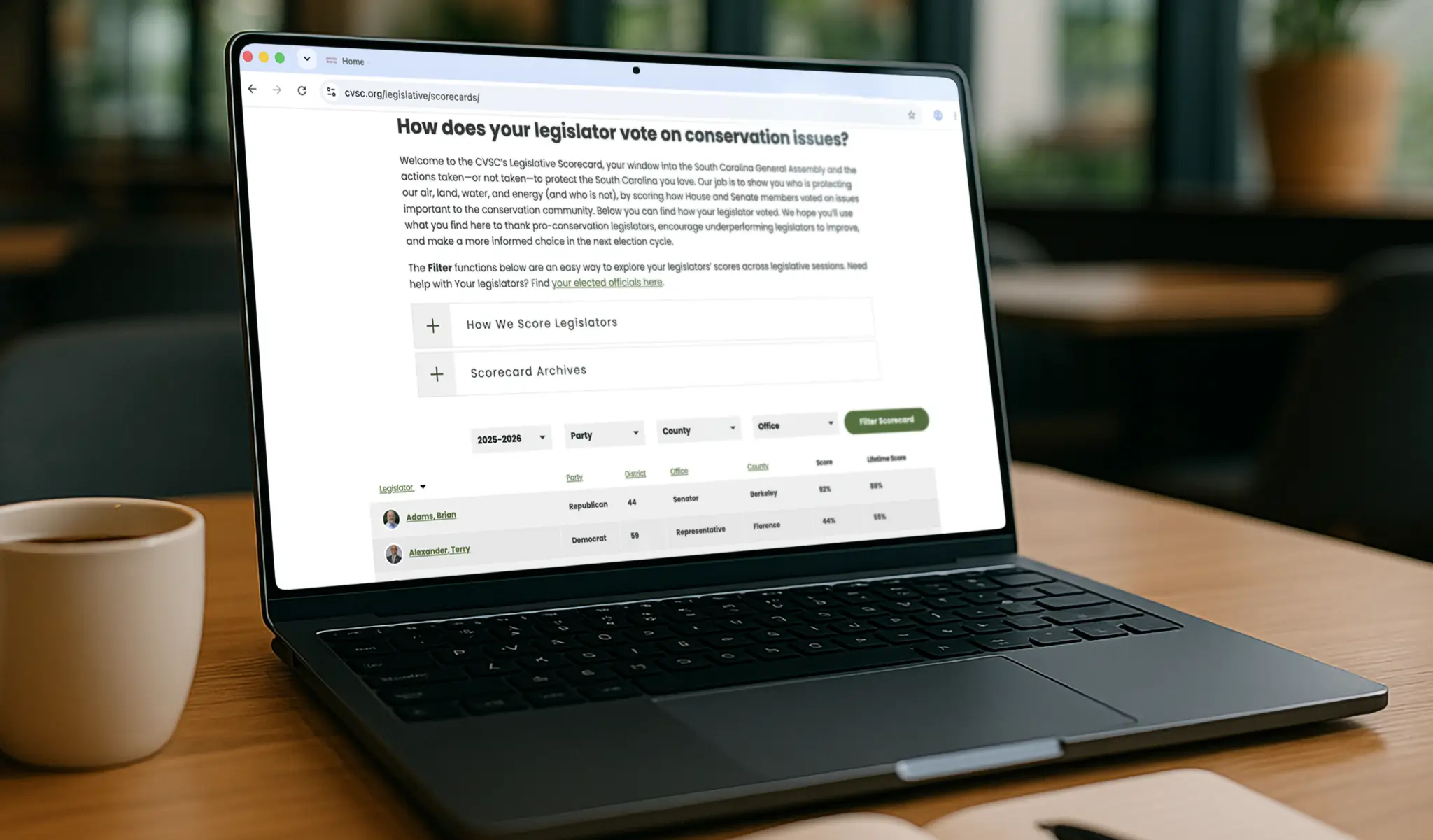
Every election cycle, voters are asked to choose between candidates with little more than campaign mailers and soundbites to go on. A good legislative scorecard replaces some of that guesswork with a record: how did this person actually vote when it counted?
We built the scorecard for Conservation Voters of South Carolina (CVSC), and it shows both what an online scorecard can do and what it takes to keep one trustworthy.
Scorecards simplify informed decision-making
They make the record findable. Legislative votes are public, but they are scattered across journals, roll calls, and bill histories. A scorecard collects them into one place and connects them to a name and a district. The CVSC scorecard lets visitors filter by session, party, county, and chamber, so a voter can look up their own senator or representative in seconds.
They make comparison possible. A single vote tells you little, but a score across a whole session lets you compare legislators in the same county, the same caucus, or the same chamber. Lifetime scores sit next to session scores, so a voter can see whether an October promise matches a pattern of behavior over many years.
Scorecards can change outcomes
Informed voting. The scorecard’s stated purpose is to help voters thank strong performers, push underperformers to improve, and make a better choice at the next election. Usable data on a legislator’s record, in place of a vague reputation, is what makes that kind of voting possible.
Coalition building. Scores show where allies already are. A legislator who scores high in a rural county may be a more persuasive messenger on a water or land issue than any outside advocate. Organizers can use the data to find unexpected champions and to decide where to invest relationship-building time.
Policy change. Legislators know they are being watched. A public, consistently maintained scorecard raises the cost of skipping a vote or voting against a position they’ve told constituents they support. Over time, the knowledge that votes will be scored can change how bills are drafted, sponsored, and whipped.
What makes a scorecard credible
A scorecard is only as useful as people’s trust in it. A few principles matter most.
- Explain the method. CVSC publishes how it scores. Voting for the organization’s positions raises a score, while voting against or not voting lowers it.
- Acknowledge what votes can’t show. CVSC notes that statistics alone are an incomplete record. Who sponsored a bill in committee, or spoke on the floor, matters too. The scorecard adds plus-or-minus adjustments for bill sponsorship, so pro-conservation sponsors gain points and sponsors of anti-conservation bills lose them. One side effect is that some scores exceed 100%, which shows the adjustment is working in the open rather than being hidden.
- Keep the archive. CVSC’s scorecards go back to 2003-2004 as downloadable PDFs, with recent sessions available in the interactive tool. History lets users trace a legislator’s trajectory.
- Make it easy to act. The page links directly to a tool for finding your elected officials, so the step from “here’s the score” to “here’s who to contact” is one click.
How Beam & Hinge built and maintains the CVSC scorecard
Our job was to make a large, complicated dataset feel simple. CVSC covers a full General Assembly, with more than 150 legislators across multiple sessions, each with a party, district, county, chamber, session score, and lifetime score.
Building it. We designed the scorecard around the questions visitors actually ask: Who represents me? How did they vote? How do they compare? That led to filterable columns for legislator, party, district, office, county, and score. Each legislator has an individual profile page, and the list is photo-forward, so it reads as a directory of people rather than a spreadsheet.
Under the hood, the scorecard is structured as connected WordPress data rather than one large table. Legislators have persistent profiles, while separate session-specific records capture information that can change over time, such as part, county, votes, and scores. Bills and individual votes are also tied to their legislative session, creating a structure that can carry a legislator’s history forward as new sessions are added.
Maintaining it. A scorecard is never finished. Each session brings new votes, new members, and occasional corrections, and a legislator’s lifetime score changes when the current session’s score does. Each new session follows a defined update workflow. CVSC provides structured data for bills, votes, and session-specific adjustments, which we import in sequence so legislators, bills, and votes are correctly matched. Together, the Beam & Hinge and CVSC teams double check the information for accuracy. The system calculates session and lifetime scores from that underlying data, and we review the imported information once more before it is published. That repeatable process helps keep the scorecard current without sacrificing accuracy. Our guiding rule is that the public presentation should never get ahead of the data. A page that looks authoritative but contains errors costs the organization more credibility than having no scorecard at all.
See potential?
Online scorecards work when they are transparent, current, and easy to use. They help voters make decisions, give coalitions a map of where support exists, and give policymakers a reason to think about how their votes will look in a public record. If your organization is thinking about building one, or fixing one that has become hard to maintain, let’s talk.
