Beam & Hinge employs AI to increase staff capacity for nonprofit Senior Resources
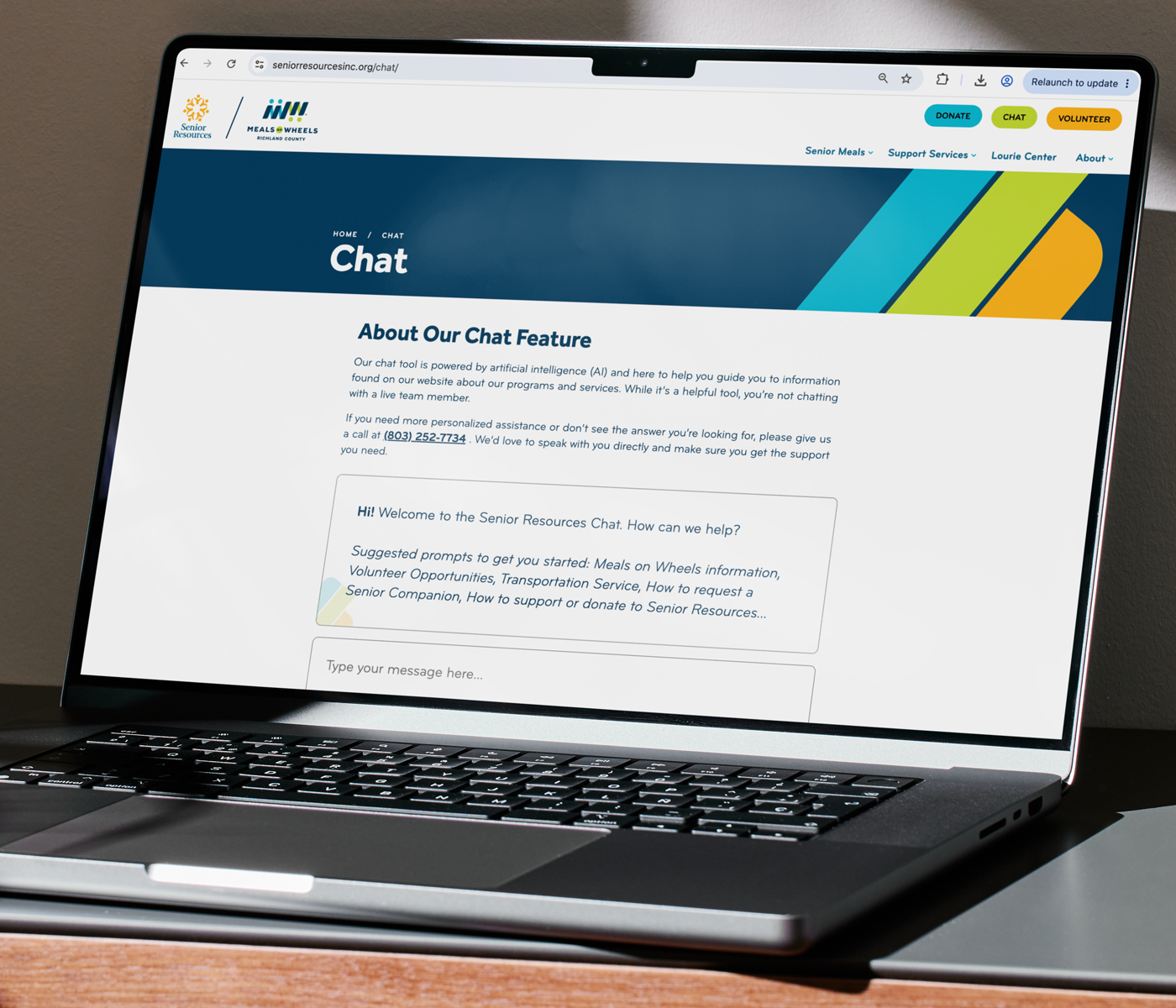
AI is, frankly, everywhere. The term is nearly inescapable these days, with proponents singing its praises and potential, and detractors grieving its threat to creativity and grit. It’s possible to employ AI responsibly, improving efficiency without sacrificing quality, as we share in this case study of our work a longtime client, Senior Resources.
Senior Resources annually provides meals and support services to thousands of senior citizens in Richland County, South Carolina. The organization is driven by the efforts of volunteers and a very capable, but small, staff. Demand for Senior Resources’ services is anticipated to more than double in the coming decades, and the organization sought a Google grant to explore the potential for artificial intelligence to augment the capacity of its human staff. Once awarded the grant, they called on Beam & Hinge for guidance and implementation.
Senior Resources has been a Beam & Hinge client since 2018, and that relationship provided a firm launch point for exploring potential opportunities to relieve stress points on the organization’s processes and activities. Our process included a needs assessment, stakeholder interviews, solution design, and technical planning to ensure that any AI feature would align with organizational objectives and user needs.
Starting with questions as simple as, “How do you spend your time?” and “Where do you expend the most energy?” quickly revealed that repetitive, basic questions from mismatched information-seekers were preventing staff members from focusing energy on higher-level operational and programmatic work.
“We heard from multiple team members that they spent an inordinate amount of time answering questions from people outside of their geographic service area, and from those seeking services that are not provided by Senior Resources,” says Katie Fox, Beam & Hinge’s Director of Content. “We needed a solution that could use AI to both relieve the time burden on Senior Resources and help folks connect with organizations that better matched their needs and location.”
A plan was set to establish an AI-driven chat bot on the Senior Resources website to handle general inquiries and relieve the volume of phone calls and emails that required substantial staff time.
The solution was required to meet this criteria:
- It needed to be cost-effective and easy to update based on user interaction.
- It needed to be trained to Senior-Resources-specific programs, FAQs, and contact protocols.
- It needed to be user-friendly, particularly for older audiences and those with limited experience with computer and/or AI technology; and it needed to communicate with the same warmth and empathy as the organization’s human team members.
Choosing the Right Model
Choosing the right AI model and supporting tools for your website is like choosing a highly customizable vehicle. There are hundreds of models to choose from, and it takes time and focus to ensure you choose a model that meets your requirements, but doesn’t overcharge you for features you don’t need (snow chains in the south, anyone?) The internal team at Senior Resources trusted Beam & Hinge to research the options and choose the pieces that could best meet the needs of their site visitors while remaining cost effective. Our lead developer brought his decades of knowledge to the process, and still spent many hours just researching and testing options. The process could feel overwhelming for a layman.
Training the Language Model
An AI chat bot for your website operates differently from the Chat GPT, Claude or Perplexity tools you might engage with for personal use. When you ask a question of ChatGPT, it seeks answers from the entirety of the internet (there are intricacies to this, but they aren’t important here.) When a visitor asks a question of your chat bot, the bot’s possible responses need to be limited to the information on your site, whether that information is public or contained in the meta data.
And so we first went back to basics: The website needed to include information that could answer the common questions that Senior Resources was receiving, even if those questions were not central to their work. We were lucky to have two great repositories of data from which to pull these questions: five years of Contact Us forms from the current website, and 1 year of call tracking notes from the Senior Resources primary phone line. It was thousands of pieces of data, so, of course, we fed it into AI to get a summary of the questions that the public was asking Senior Resources.
In order for the chat bot to find the answers to those questions within the new website, we implemented that information in two ways: through an advanced FAQ section and a new directory of organizations that provide complementary services to those of Senior Resources.
Now, if a visitor asks the chat bot, “I am a senior citizen. How do I get help paying my electricity bill?” it can return information about appropriate aid organizations that are listed in the directory, while also clearly stating the Senior Resources does not offer that form of assistance.
With the new information added to the site, we set parameters in the search tool to limit the pages, posts, and files that the search tool could access; as well as the level of extrapolation it could employ based on the site’s information. We also set limits on how many back-and-forth interactions a visitor could have in a given session, with a goal of not frustrating users. If they can’t find what they seek by clarifying their request more than twice, they are directed to call Senior Resources.
Keeping It User-Friendly
The savviest chat bot in the world is useless if its interface is confusing or off-putting. The friendly, welcoming design of the Senior Resources website is a great start, and some very specific choices were made to ensure that the chat feature isn’t intimidating or intrusive.
Keeping things clean and clear was important, and so the chat bot is not superimposed over the primary page (as is common). Instead, the Chat option has its own button in the main navigation, and that button opens a page that houses only the Chat feature. This allowed us to keep the text large and the content field spacious; and to give space to instructions for using the feature.
It was important to Senior Resources that their chat bot respond to clients with the same warmth and empathy shown by their human team members. The voice of the bot required coaching related to phrasing, information structure, and tone. Our team spent a lot of time asking the bot questions and tweaking its voice before the website even launched. We even employed some of our own parents as test users!
Keeping It User-Friendly
The new Senior Resources website, complete with its AI chat bot, launched in early March. In reviewing the logs from chat bot conversations, the Senior Resources team has recognized that one opportunity for site improvement is to clarify the fee structure for their services, which ranges from free offerings for qualifying applicants to membership subscriptions for the Lourie Center. This summer the Beam & Hinge content team will work with Senior Resources to seed that information across the site. Moving forward, quarterly reviews like these will ensure that the chat bot can find accurate, current information about Senior Resources programs as the shift and grow.
An AI-powered chat bot isn’t the anwer to all of your organization’s challenges, but it could be a great tool for helping your current and potential clients while freeing up time for your staff. If you’re interested in discussing options for your organization, we encourage you to contact your account manager.
